Standing Water or a Soggy Spot in the Yard: Signs Your Drain Field Is Failing
A wet patch in the yard could be a drainage issue, a leaky irrigation line — or your drain field telling you it’s in trouble. Here’s how to tell the difference, and what the different patterns of wetness usually mean.
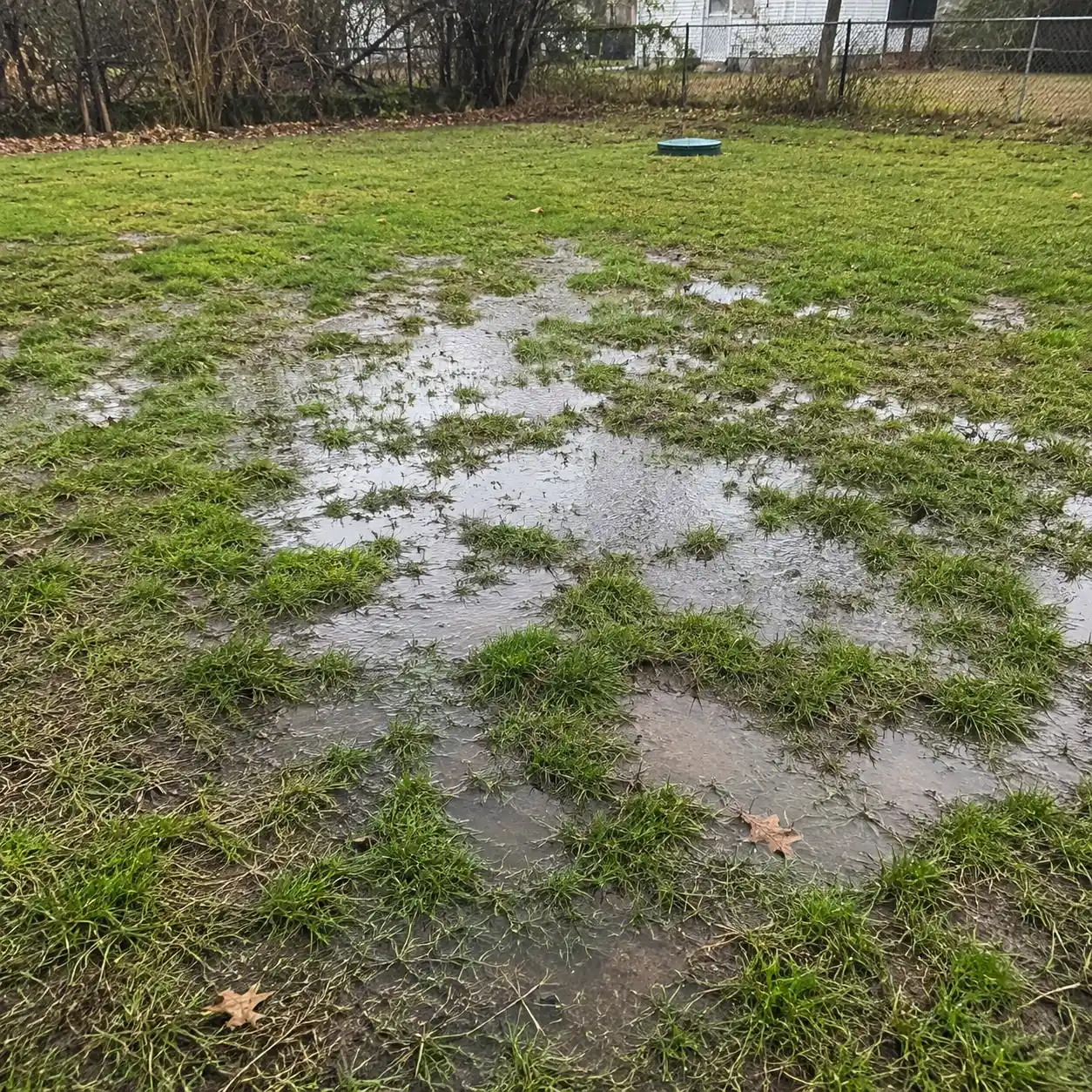
Not Every Wet Spot Is a Septic Problem
Yards get wet for all kinds of reasons that have nothing to do with a septic system — poor grading that channels rainwater to one low spot, a downspout dumping water in the same place every storm, an overzealous irrigation zone, or just naturally soggy ground in a low part of the property. Before assuming the worst, it’s worth ruling those out, since the fix for a grading issue is a lot cheaper than a drain field repair.
That said, if the wet spot lines up with where your drain field actually is, shows up regardless of recent rain or irrigation, or comes with any of the other signs below, it’s worth taking seriously. Here’s how to tell a genuine field problem from ordinary yard drainage.
If you don’t already know where your drain field is located, that’s the first thing worth figuring out before working through the signs below. County permit records, if the system was installed after a certain date, sometimes show the layout. If not, look for the general area downhill from the tank, often marked by a slightly different grass color or texture even when everything’s working normally, since the soil composition over a field is rarely identical to the surrounding yard.
It’s worth mentioning up front that steep or heavily wooded lots — common across a lot of Buncombe County — can make this harder to judge by eye than it would be on a flat, open yard. A field built into a hillside might sit at an angle rather than in one obvious flat section, and tree cover can mask early symptoms that would be more visible on open ground. If your property fits that description, it’s especially worth having someone confirm the field’s exact layout rather than relying purely on visual inspection from a distance.
Sign 1: The Wet Spot Follows the Shape of Your Field, Not the Landscape
Ordinary drainage problems usually follow the natural low points of a yard — wherever water would pool regardless of what’s underground. A failing drain field, on the other hand, tends to produce wetness in a pattern that matches the shape of the buried field lines themselves — straight or rectangular sections, sometimes with individual lines visible as slightly raised, soggier strips in the grass.
If you know roughly where your field is, this is one of the more reliable ways to tell the two apart. A wet area that traces the field’s outline is a stronger signal than one that just happens to sit in a low corner of the yard.
Sign 2: It’s Wet Even When It Hasn’t Rained
Rain-related wetness is normal and expected, even over a healthy drain field during a heavy storm. What’s not normal is standing water or soggy ground that persists during a dry stretch, days after the last rain. That points toward effluent surfacing on its own, independent of weather, which usually means the field has stopped absorbing water the way it’s supposed to.
Sign 3: The Grass Over the Area Is Noticeably Greener or More Lush
Effluent acts as a natural fertilizer, so a section of drain field that’s surfacing — even subtly, without visible standing water — often produces grass that’s a distinctly different shade of green than the rest of the yard, or that grows faster and needs mowing more often. This is sometimes the earliest visible sign, showing up before actual wetness does.
Sign 4: There’s a Sewage Smell Near the Wet Area
Wet ground paired with an odor, rather than wet ground alone, is a stronger indicator of a field problem than either sign by itself. Ordinary drainage issues don’t typically smell like sewage — if yours does, that combination is worth getting looked at soon rather than waiting to see if it dries out on its own.
Sign 5: Drains Inside the House Have Also Gotten Slower
A drain field that’s struggling to accept effluent doesn’t just show symptoms outside — it backs pressure up through the whole system, which often shows up as slower drains throughout the house around the same time the yard symptoms start. If you’re noticing both at once, that combination points more clearly toward the field than either symptom on its own.
Sign 6: It’s Gotten Worse Over Weeks or Months, Not Just After One Storm
A field that floods temporarily during an unusually heavy storm and then dries out within a day or two is behaving normally — even a healthy field has limits during extreme weather. A wet area that’s been getting progressively worse, staying wet longer after each rain, or expanding to cover more ground over a period of weeks is the pattern that points toward an actual decline rather than a one-time event.
Sign 7: The Ground Feels Spongy or Squishes Underfoot, Even Without Visible Water
Not every case of a saturated field shows visible standing water — sometimes the ground just feels different. A spot that squishes or gives noticeably underfoot compared to the surrounding yard, even without any pooling you can see, can indicate the soil directly beneath is holding more moisture than it should. This is easy to miss unless you’re specifically walking the area, which is worth doing periodically if you already suspect something might be off, especially after a stretch of dry weather when the rest of the yard should feel firm.
Wet Spot That Won’t Go Away?
Let’s find out if it’s your drain field or just your yard.
Schedule a Diagnostic Visit
Serving Asheville and all of Western North Carolina.
What Causes a Drain Field to Actually Fail
Fields fail for a handful of common reasons: age and gradual soil compaction over decades of use, a system that was undersized for the property from the start, root intrusion into the lines, a broken distribution box sending too much flow to one section, or simple overloading from more water use than the field was ever designed to handle. On a lot of Buncombe County properties specifically, shallow soil over bedrock means there was less margin for error in the original design, so problems here can show up sooner than they would on a deep-soil property elsewhere.
Knowing which of those is actually happening on your property is the difference between a relatively inexpensive repair and a full field replacement — which is exactly why digging a few test pits before quoting anything matters more than guessing from the surface symptoms alone.
It’s worth saying plainly: a wet spot doesn’t automatically mean the whole field is finished. We see plenty of situations where a single failed distribution box was sending nearly all the flow to one section of an otherwise healthy field, which produced exactly this kind of localized wetness while the rest of the field was working fine. Jumping straight to “the field needs replacing” without confirming that first can mean paying for a lot more work than the property actually needs.
What Happens Next If It Is the Field
If the signs above point toward an actual field problem, the next step is a proper diagnostic visit — test pits across the field to see where and how deep the saturation actually goes, along with a look at the distribution box and an honest read on whether this is a localized, fixable issue or something that’s affected the whole field.
In the meantime, easing off water use and avoiding anything that adds extra load — long showers, back-to-back laundry loads, running the dishwasher and washing machine at the same time — can help keep things from getting worse while you get it looked at, though it won’t fix the underlying cause on its own.
One more practical note: avoid the temptation to just add more soil on top of the wet spot to even out the yard, or to plant something water-hungry there to “soak it up.” Both can mask the visible symptom without addressing what’s actually happening underground, and adding fill can sometimes make a marginal field’s situation worse by further compacting the soil above it. Better to get an honest diagnosis first and handle the landscaping afterward, once you know what you’re actually dealing with.
Get Your Drain Field Checked
Whether it turns out to be a simple grading fix or an actual field problem, fill out the form and we’ll help you sort out which one you’re dealing with.
- Test pit diagnosis
- Distribution box inspection
- Drain field repair
- Field expansion when needed
- Written repair-vs-replace options
- Serving all of Buncombe, Henderson, Madison & Haywood counties
Tell Us About Your Needs
We’ll reach out to confirm your appointment details.