Why Does My Yard Smell Like Sewage?
A sewage smell outside is one of those things that’s easy to dismiss the first time and hard to ignore the third. Here’s what’s actually causing it, from the boring fixes to the ones that need a professional look — and how to tell which one is happening at your place.
It’s Not Always the Obvious Answer
The instinct when a sewage smell shows up in the yard is to assume the tank’s full and needs pumping. Sometimes that’s exactly right — a tank that’s overdue lets gas build up past what the surrounding soil can absorb, and it finds its way to the surface. But “pump it and see” isn’t always the fix, and if the actual cause is something else, you can pay for a pump-out and still be smelling the same thing a week later.
The honest answer is that a handful of different problems produce the same basic symptom, and telling them apart usually comes down to where the smell is strongest, whether it’s constant or comes and goes, and what else is happening around it — slow drains, wet ground, gurgling pipes. Walking through the most common causes, roughly in the order we see them, is the fastest way to narrow it down before calling anyone out.
It also helps to think about timing. A smell that showed up suddenly, out of nowhere, points toward something that changed recently — a line that just cracked, a lid that just got knocked loose, a field that just crossed a threshold it had been approaching for a while. A smell that’s been faint and occasional for months, gradually getting more noticeable, points more toward a slow decline — a tank creeping toward its pumping interval, or a field losing capacity a little at a time. Neither pattern tells you the exact cause on its own, but combined with where the smell is strongest, it narrows things down considerably before anyone even needs to dig.
Cause 1: A Tank That’s Genuinely Overdue for Pumping
This is the straightforward one. As sludge and scum build up inside the tank, less of the tank’s internal volume is available to hold gas, and eventually pressure pushes it out through the vent system or, in some cases, past a lid that isn’t perfectly sealed. If it’s been more than five years since the last pumping — or you don’t actually know when that was — this is worth ruling out first, since it’s also the cheapest problem to fix if it turns out to be the actual cause.
One thing worth checking: does the smell track with fixture use? A tank-related smell often gets noticeably stronger after a lot of water goes down the drains at once — a full load of laundry, a house full of holiday guests — because that surge of water pushes gas out ahead of it. If you notice the pattern lines up that way, a tank that’s simply due for service becomes the more likely explanation.
Cause 2: A Cracked, Loose, or Poorly Sealed Tank Lid
Septic tank lids aren’t airtight by accident — they’re supposed to hold gas inside so it vents properly through the plumbing system’s vent stack instead of leaking out at ground level. Over time, older concrete lids can crack, especially if something heavy has driven or been parked over them, and the gasket or seal around a riser lid can degrade and let gas escape directly into the yard.
This kind of smell tends to be localized — strongest right at the tank’s location, weaker just a few feet away — which is a useful clue if you know roughly where your tank sits. It’s also one of the easier fixes: a damaged lid gets replaced, not the whole tank, and it’s often something we catch and correct during a routine pumping or inspection visit before it becomes the reason you called.
Cause 3: A Drain Field That’s Reaching Its Limit
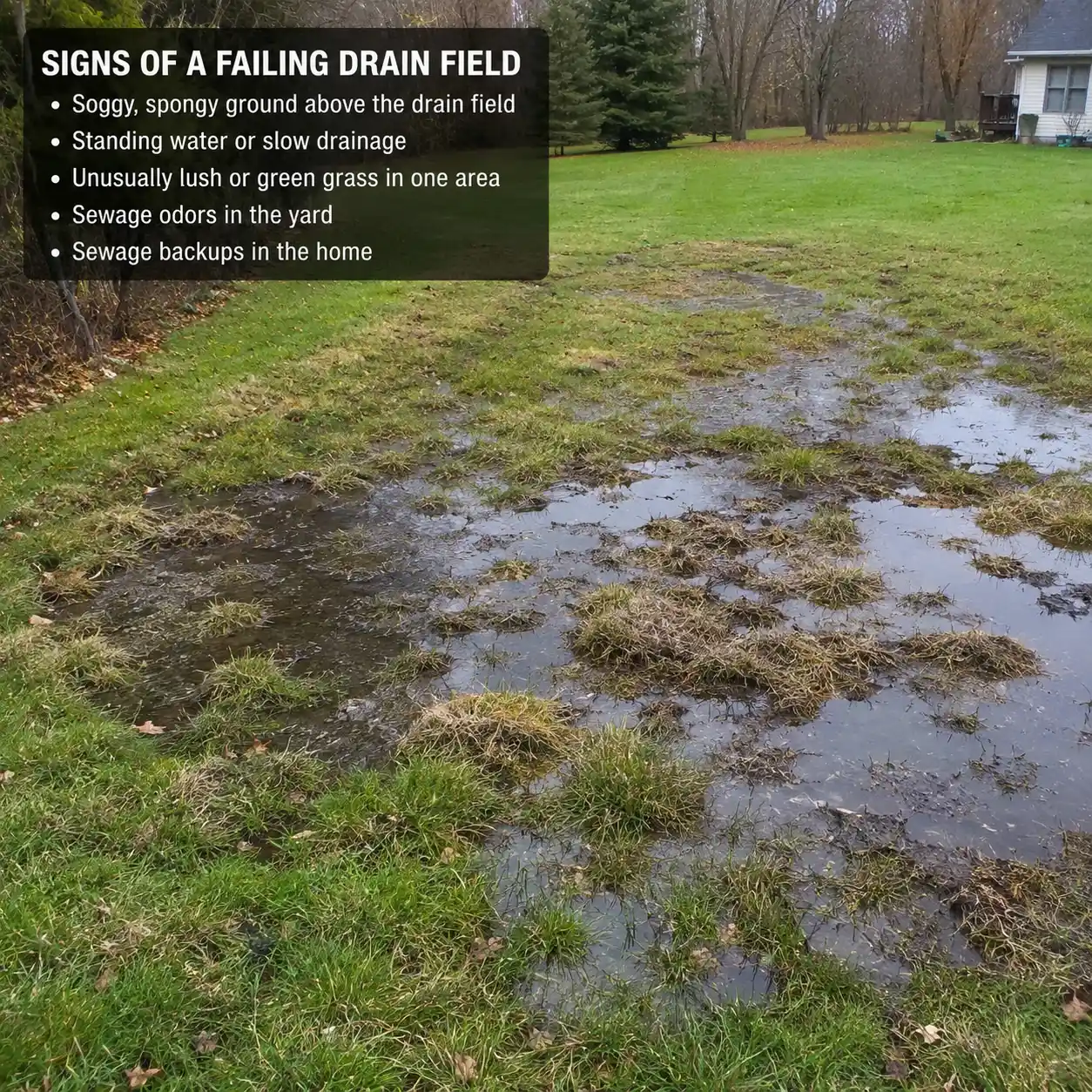
If the smell is spread across a wider area — over the whole field rather than one specific spot — the drain field itself may be struggling to keep up. As a field nears the end of its usable life, or gets overloaded by more water than the surrounding soil can absorb, effluent doesn’t fully filter through before it reaches the surface, and it brings odor with it.
On a lot of Buncombe County properties, this shows up specifically after a heavy rain, because a field that’s already working near its capacity has even less room to spare once the surrounding soil is already saturated with rainwater. If the smell gets noticeably worse after storms, the field — not the tank — is the more likely source, and it’s worth having someone dig a few test pits rather than guessing.
Shallow soil over bedrock, common across a lot of this region, plays into this more than people expect. A field with only a foot or two of usable soil before hitting granite or gneiss simply has less filtering capacity to begin with, so it takes less of an overload — a garbage disposal running heavily, an extra household member, a long stretch of wet weather — to push it past what it can handle. That’s part of why the same symptom can show up sooner here than it would on a property with deep, well-draining soil elsewhere in the state.
Cause 4: A Blocked or Damaged Vent Pipe
Every septic system has a vent that lets gas escape safely above roofline, where it disperses instead of collecting near the ground. If that vent gets blocked — by a bird’s nest, debris, or even ice in colder months at higher elevations — gas has to find another way out, and it often does that through the tank lid, a cleanout, or wherever else there’s a gap in the system.
This one’s less common than the others but worth ruling out if the smell seems to be coming from near the house itself rather than out in the yard, especially if you also notice a faint smell inside near a specific bathroom. A quick look at the roof vent, or a call to have it checked, usually settles the question.
Cause 5: A Leaking or Broken Sewer Line Before the Tank
The pipe running from your house to the tank can crack, separate at a joint, or get crushed by root growth or ground settling, and when it does, wastewater seeps into the soil along its path rather than reaching the tank at all. This tends to produce a smell along a specific line between the house and where the tank sits, rather than concentrated at either end.
It’s also one of the causes most likely to come with a visible symptom alongside the smell — a soggy strip of ground tracing a line across the yard, or grass that’s unusually green along that same path. If you can trace a line like that from the house toward where you think the tank is, mention it when you call; it tells us roughly where to start looking.
Cause 6: It Might Not Be the Septic System at All
Before assuming it’s the septic system, it’s worth ruling out a couple of household causes that produce a very similar smell. A dry P-trap under a rarely used sink, floor drain, or in a basement can let sewer gas back up through the plumbing, especially in a room that doesn’t get used often. Running water down that drain for a minute usually resolves it immediately, which is a fast, free way to test the theory before assuming the worst.
A nearby storm drain, especially right after heavy rain, can also produce a sewage-adjacent smell that has nothing to do with your system. If the smell is strongest near the street rather than anywhere close to your tank or field, that’s worth considering too before you schedule a visit for something that isn’t actually your system’s fault.
Smelling Something You Can’t Explain?
Tell us what you’re noticing and we’ll help you figure out where it’s coming from.
Schedule a Diagnostic Visit
Serving Asheville and all of Western North Carolina.
What to Do About It
If you’ve narrowed it down to a likely cause using the list above, the next step depends on which one it is. A tank that’s simply overdue just needs pumping. A cracked lid needs replacing, which is usually quick and inexpensive. A struggling drain field or a broken line before the tank are the two that call for an actual diagnostic visit, since guessing wrong on either one means spending money on the wrong fix and still having the same smell afterward.
In the meantime, it’s worth easing off water use if you can — spacing out laundry loads, keeping showers reasonably short, holding off on running the dishwasher back-to-back with anything else. Reducing the load on the system won’t fix the underlying problem, but it can keep symptoms from getting noticeably worse while you get it looked at properly.
It’s also worth resisting the urge to reach for a septic additive marketed as an odor fix. Most of these products don’t address any of the six causes above — they’re not going to repair a cracked lid, clear a blocked vent, or restore capacity to an overloaded field. At best they mask the symptom temporarily; at worst, some formulations actually disrupt the bacterial balance a healthy tank depends on, which can make the underlying problem worse over time rather than better.
When to Call Someone vs. When to Wait
A mild, occasional smell that shows up after unusually heavy household use is a reasonable thing to watch for a few days rather than treat as an emergency. A smell that’s constant, getting stronger over time, showing up alongside slow drains or wet ground, or accompanied by any sign of actual sewage backing up inside the house is worth getting looked at sooner rather than later — that combination of symptoms usually means the problem has moved past the early stage.
If you’re in Buncombe County or the surrounding area and you’re not sure which category your situation falls into, that’s a completely normal reason to reach out. A quick description of what you’re noticing — where the smell is strongest, whether it comes and goes, and anything else happening around it — is usually enough for us to tell you honestly whether it’s worth a same-week visit or something that can wait for a routine appointment.
Get Your Yard Smell Diagnosed
Whether it’s a quick lid replacement or something that needs a closer look at the drain field, fill out the form and we’ll help you figure out what’s going on.
- Tank & lid inspection
- Vent system check
- Drain field evaluation
- Line leak diagnosis
- Straightforward repair recommendations
- Serving all of Buncombe, Henderson, Madison & Haywood counties
Tell Us About Your Needs
We’ll reach out to confirm your appointment details.